
Free Math Activities for Neurodivergent Children — Learn by Touching, Not Testing

SocialDiverse Admin
Published · 3 min read
403 views
1 likes
0 comments
0 shares
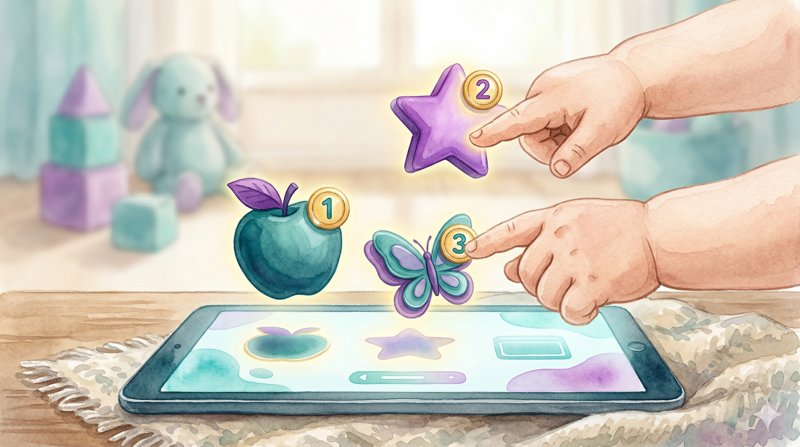
Most math apps treat learning like a test. Timer counting down. Red marks for wrong answers. Points deducted. For a neurodivergent child, that's not learning — that's stress.
What if math felt like playing with toys instead?
## Why Most Math Apps Don't Work for Neurodivergent Learners
Children with autism, ADHD, or sensory processing differences learn differently. They need:
- **Objects before numbers** — see 3 apples before seeing the digit "3"
- **No time pressure** — take as long as they need
- **No failure states** — guidance instead of punishment
- **Multi-sensory input** — see it, hear it, touch it
Most apps skip straight to abstract numbers and flash "WRONG!" when a child is still figuring things out.
## Meet Math Explorer on SocialDiverse
We built Math Explorer specifically for neurodivergent learners. It teaches math the way children naturally understand it — through objects, counting, and play.
No scores. No timers. No wrong answers. Just gentle guidance and lots of encouragement.
## How It Works: 5 Progressive Modules
### 1. Quantity Awareness
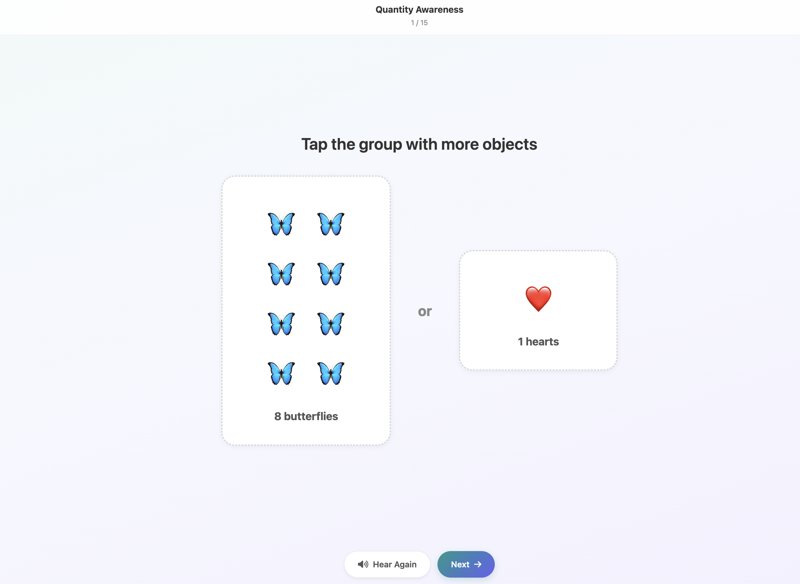
Two groups of objects appear on screen. Which group has more apples? Which has fewer stars? Children tap to choose — building an intuitive sense of "more" and "less" before ever seeing a number.
### 2. Counting Objects
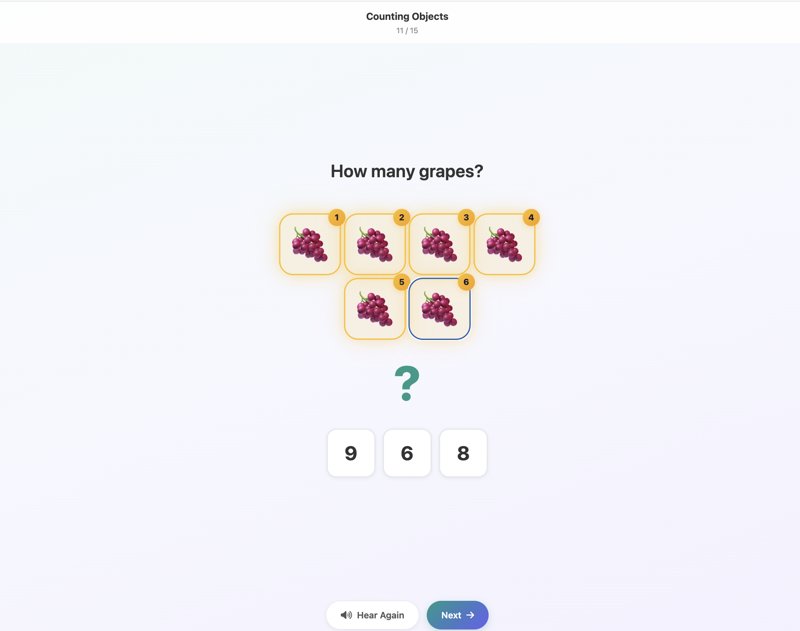
Colourful objects appear — butterflies, bananas, teddy bears. The child taps each one to count. A warm voice counts along: "one... two... three..." Each tapped object gets a golden badge showing its number. After counting all objects, the child types how many they counted.
### 3. Number Recognition
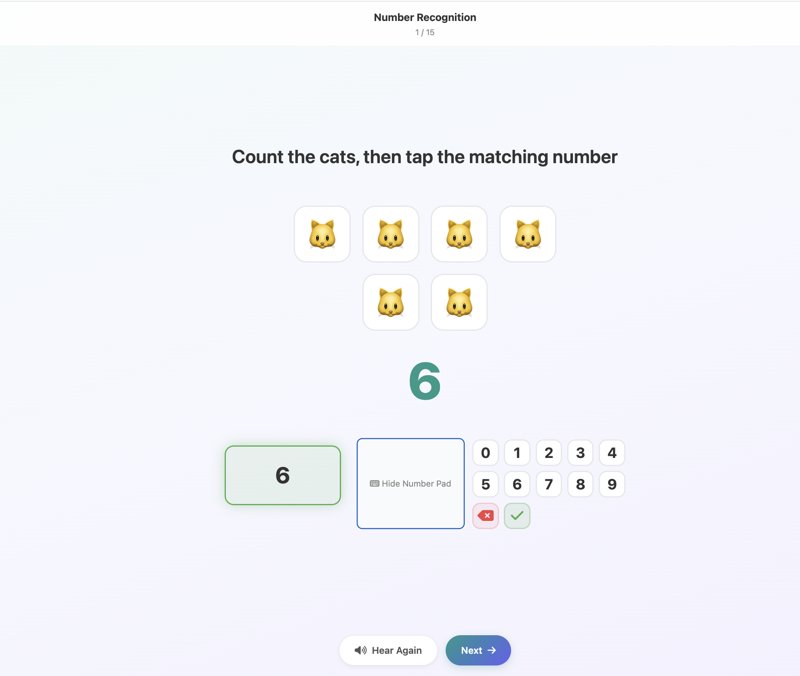
Objects appear on screen. The child counts them and types the number. No multiple choice giving away the answer — they figure it out themselves. If they type a number that's too high, a gentle voice says "A little less, count each one slowly." Too low? "A little more, try counting again." The objects even flash one by one as a counting hint.
### 4. Simple Addition
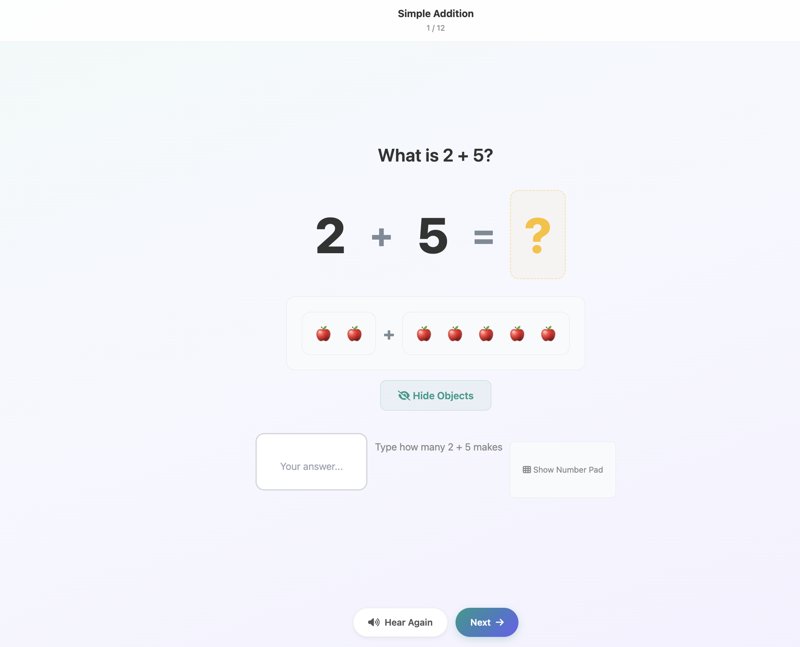
The screen shows "3 + 2 = ?" using large, clear numbers. The child types their answer. Need help? A "Show Objects" button reveals the actual apples or stars — making the abstract equation concrete and countable.
### 5. Simple Subtraction (Coming Soon)
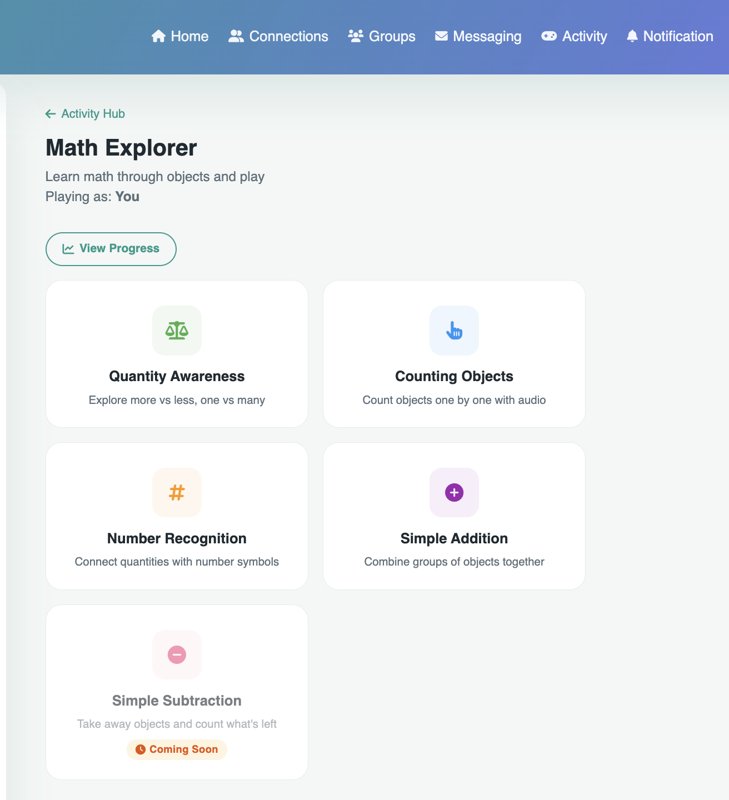
Tap objects to make them disappear, then count what's left. A hands-on way to understand taking away.
## What Makes It Different
**Objects First, Numbers Second** — Children see real things (fruits, animals, shapes) before they see digits. Math becomes tangible.
**Zero Failure Design** — There is no "wrong answer" screen. If a child picks the wrong number, the system gently guides them: "Almost! Try counting again." Objects pulse as a visual hint. The child can try unlimited times.
**Soothing Voice** — A calm, warm voice counts along and celebrates: "Beautiful work!" "You did it!" "Wonderful!" Never robotic, never harsh.
**Works on Any Device** — Large touch targets for tablets (56px minimum), responsive layout for phones, keyboard support for desktop. No app download needed — works right in the browser.
**5-Minute Free Preview** — Try it without signing up. No credit card, no download, no login required.
## Tips for Parents and Educators
1. **Keep sessions short** — 5-10 minutes is perfect. End while the child is still engaged.
2. **Start with Counting** — It's the most intuitive module. Let children tap and hear the numbers.
3. **Don't rush to numbers** — Spend time on Quantity Awareness first. Understanding "more vs less" is foundational.
4. **Let them repeat** — Unlimited repetition is built in. Repetition builds confidence.
5. **Try the Show Objects button** — In Addition, showing the actual objects makes abstract math concrete.
6. **Use the slowest voice speed** — Give the child time to process what they hear.
## Built by a Parent Who Understands
Math Explorer was built by a neurodiversity parent who watched her child struggle with apps that punish mistakes. Every interaction, every voice prompt, and every visual choice was designed with neurodivergent children in mind.
It's completely free. No subscription. No hidden costs.
**Try Math Explorer now:** [socialdiverse.com/activities/math](https://socialdiverse.com/activities/math/) — no login needed.
Follow us on [Instagram](https://www.instagram.com/socialdiverse.official/) for tips, activities, and community stories.
You're exploring something meaningful
Join India's neurodiversity community to read the full article, connect with experts, and access resources that make a difference.
Free forever — no credit card needed
Already a member?
Log in to continue reading

0 Comments
Join the conversation
Share your thoughts — log in or create an account to comment.